

Before Agnes: Where They Came From
↑ Back to topThe story of Agnes Rebik does not begin in Iowa. It begins in Bohemia.
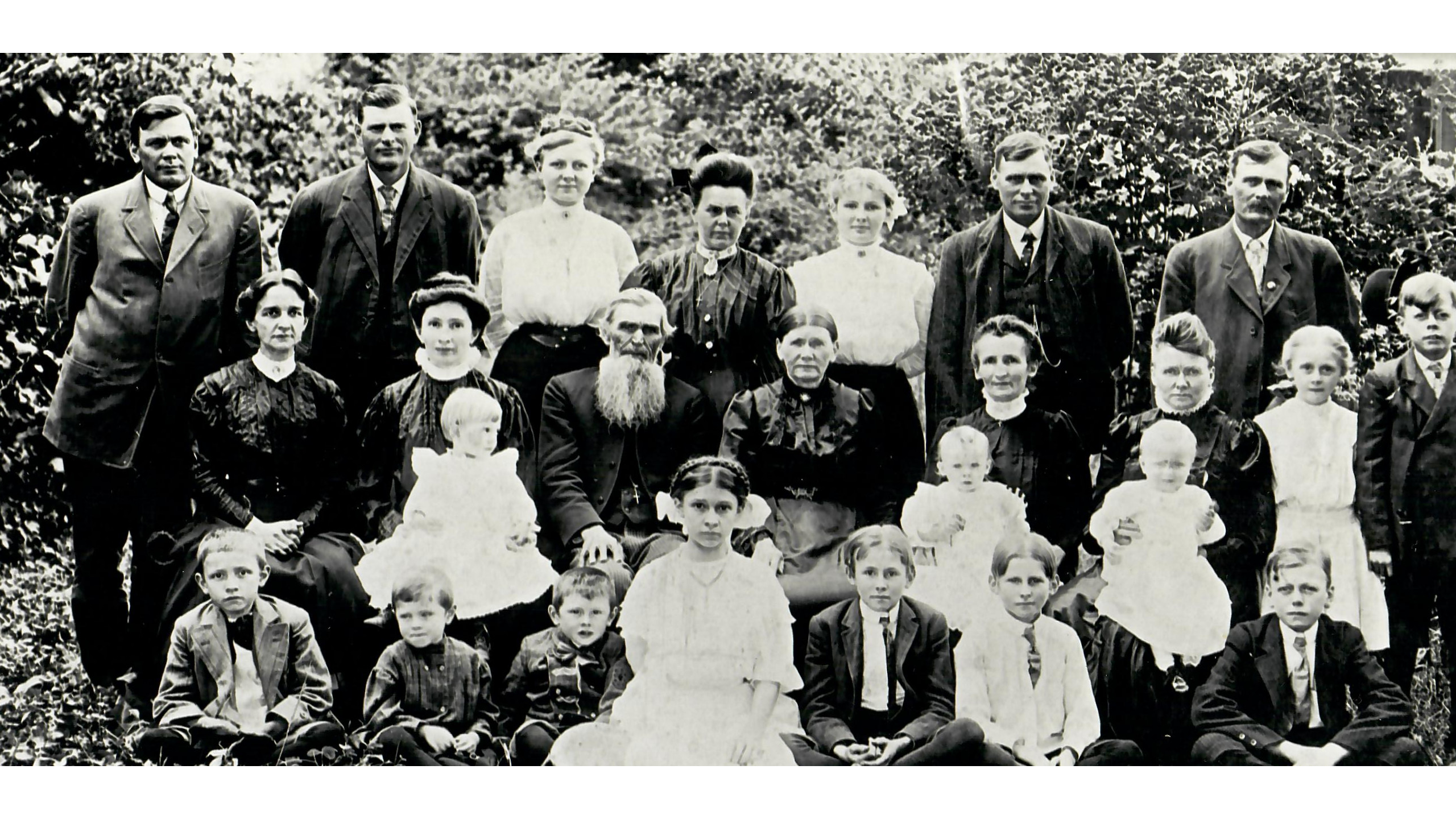
In the mid-nineteenth century, the rolling farmland of Tama County, Iowa was being quietly settled by a wave of Czech immigrants — families who had crossed the Atlantic from the Kingdom of Bohemia, then part of the Austrian Empire, in search of land they could own and work on their own terms. Among them were the people who would, in time, become Agnes's grandparents on both sides. They came separately, by different ships, in different years. They found each other in the same corner of Iowa. And they stayed.
On her mother's side, Agnes's grandmother was Barbara Hlavacek, born in Bohemia in May of 1836. She arrived in Iowa in 1867 and first married a man named Zeman, with whom she had three sons — Frank, Joe, and John, born between 1860 and 1869. Within the week after Zeman's death, Barbara married Anton Babor in September of 1869. Anton had also come from Bohemia in 1867, born there in March of 1841. Together Barbara and Anton put down roots in York Township, Tama County — the same township where Agnes would be born nearly forty years later. Their daughter Anna Babor came into the world in Iowa in February of 1875, the first generation of the family born on American soil. Anton lived until July 29, 1921 — long enough to know his granddaughter Agnes as a young teenager. Barbara outlasted him by nearly a decade, dying in December of 1930, when Agnes was twenty-three and already a young wife and mother.


Anna Babor married Frank Shanda Jr. on October 1, 1900, in Irving, Tama County. Frank was the son of Frank Shanda Sr. — born in Bohemia in 1833, died in 1914 — and Anna Fau, who had arrived in America in 1872, born in 1843, and lived until 1927. Frank Jr. had laid railroad track for a dollar fifty a day before turning to farming. Together Frank and Anna Shanda worked their way from a rented start to a 75-acre farm they could call their own — land Frank had cleared, fenced, and built upon board by board. On September 20, 1907, their daughter Agnes came into the world there.

On her husband's side, the immigration story runs just as deep. Milo Rebik was born November 11, 1901, in Otter Creek Township — the son of Michael Rebik and Josephine Suchy. Michael had been born in York Township on October 30, 1870, to Vaclav Vencil Rebik and Barbora Novak, who had married in Prague in 1860 before making the crossing to Iowa. Vaclav died in Vining in 1891; Barbora followed in 1906. Michael grew up to become not only a farmer but a skilled carpenter — it was said there was not a farm in the Tama and Toledo area where he had not worked on building houses and barns. He married Josephine Suchy on September 25, 1893. Josephine's father, Martin Suchy, had come by steamship from Plzeň in western Bohemia in 1887. Josephine was born in 1879 and died June 15, 1954.
What this means is that when Agnes Mary Shanda and Milo Martin Rebik stood together at St. Mary's Church in Vining on September 2, 1924, they were not simply two young people from neighboring farms. They were the grandchildren of Bohemia — the harvest of a generation that had crossed an ocean, cleared land, built churches, and planted the Czech language so deeply into Tama County soil that it simply became the air everyone breathed. Every neighbor for miles was Czech. Every song at the feather bees was Czech. The Catholic faith, the kolaches, the accordion music in cleared-out parlors on winter nights — all of it carried from Bohemia and set down in Iowa, where it took root and held.
Agnes was born into that world. She didn't choose it — she simply was it, as naturally as the morels that came up in the timber every spring.
Roots in the Iowa Prairie
↑ Back to topAgnes Mary Shanda came into the world on September 20, 1907, in a two-room farmhouse nestled on a hilly, timbered stretch of land in York Township, Tama County, Iowa. Her parents, Frank and Anna Babor Shanda, had married on October 1, 1900, and worked their way from a rented life near Irving to a 75-acre farm. The doctor who attended Agnes's birth, a young physician named Dr. Pace who came out from Elberon by horse and buggy, would become a familiar name in her memory.

By the time Agnes was two, her parents had added a dining room, a kitchen, a pantry, front and back porches, and two rooms upstairs to the modest house. The farm grew in every direction: fruit trees of every variety, a vegetable garden, an orchard of apples kept fresh in an outdoor cave through winter, wild black raspberries to be picked from the timber, hickory and hazel nuts, and mushrooms — morels in spring, cap mushrooms in fall — which Agnes's mother dried on window screens and used in soups and eggs all winter.
Agnes was the middle child in birth and spirit. Her brother Joe was six years her senior, and she would wait eight full years before a younger sibling arrived — her brother Emil. She always wished for a sister. But she had her cousin Bessie, the same age, living nearby, and the two were inseparable — in school, in the fields, at every neighborhood gathering.
"I had a cousin my age who lived close by and we spent most of our young days together, were in the same grade in school. We were like sisters."
— Agnes, in her own words, 1990

Frank Shanda was a strict and hardworking man. His wife Anna was the kind of woman the whole community relied upon — willing, generous, and always available to help. Together they shaped a household that asked much of everyone in it, expected self-sufficiency as a matter of course, and wasted nothing.
A Schoolgirl's World
↑ Back to topAgnes started school at five years old — no kindergarten in those days — walking with the neighbor children to York School No. 8, about a mile and a half by road, though they almost always cut across the fields to shorten the trip. Her first teacher was a young woman named Libbie Novak. After her came a new face nearly every year, teachers who boarded with families in the neighborhood and made do with a pot-bellied stove in the center of the room and a shared tin cup from which every child drank the water two pupils hauled from a nearby farm.


Agnes went through eighth grade, as most country children did. High school was a rarity — something reserved for those who intended to become teachers. Her favorite subjects were reading and spelling, and she carried her lunch in a dinner pail every day: butter sandwiches, jelly sandwiches, molasses on bread, whatever was at hand. No milk. No hot food.
"The children gave a program at Christmas time always. Each child recites a piece... sheets were used for curtains strung on wires. Each family brought a lantern to light up the school house and all children got a small sack of something from Santa Claus. That was quite an occasion."
— Agnes, recalling school Christmas programs
School was not simply a place of learning — it was the social heartbeat of the township. The end-of-year picnic, attended by mothers who could make it, was another occasion Agnes remembered warmly. The world beyond the farm was small and knowable, and Agnes learned its rhythms by living them.
The Life of the Farm
↑ Back to topGrowing up on the Shanda farm meant growing up inside a closed loop of production and consumption that left almost no room for waste. Every season had its demands, and Agnes was part of fulfilling them from an early age. She carried wood, hauled cobs, fed the chickens, and later took up milking.
The food of Agnes's childhood was entirely homegrown, and she remembered it with unmistakable affection. Her mother's cottage cheese, made from soured milk skimmed and curdled on the back of the stove, was served with sorghum on bread and a spoonful of sour cream. The sorghum itself was a production: Anna Shanda would spend a full day at a neighbor's cane press, stirring a great vat of cane juice as it reduced, skimming the green foam off the top, until it thickened into the dark syrup that sweetened breads, kolaches, and taffy all winter long.
"We made taffy in an iron skillet, cook till thick, pour on a platter, let cool, then pull it out. Nuts were good in it too or a syrup made to make popcorn balls. Everything was good those days."
— AgnesButchering was an autumn ritual carried out with practiced efficiency. A large hog would be slaughtered when the weather cooled, the meat cold-packed in stone jars covered with rendered lard, the bacon and hams set in brine and smoked. Crackling from the fried-out lard was eaten as a snack, folded into cornbread, or reserved for making soap. Nothing was wasted: the head meat was cooked, ground, seasoned, and stuffed into casings; the pigs' feet were pickled; even the fat skins went into soup.
The neighborhood feather bees were among the most cherished memories of her girlhood. When a family had accumulated enough duck or goose feathers, they hosted a bee — ostensibly a work party to strip feathers from their quills for pillows and feather ticks. The gathering was meant to be a surprise. Neighbors arrived with baskets of food. Women sat around long tables stripping feathers and talking, often singing the Czech songs everyone in the community knew. And sometimes, when the work was done early enough, the heating stove was dragged out to make room, an accordion appeared, and dancing filled the parlor. Agnes learned to dance at a feather bee when she was about eight or nine.
"Men came for the women in the evening with bob sleds if a lot of snow. Nobody minded the cold and a good time was held by all."
— Agnes, on the feather beesMilo
↑ Back to topAgnes met her future husband, Milo Rebik, at a neighborhood barn dance. She was fourteen years old. The first date was a party, and Milo drove a Model T touring car. He was the one who proposed. Their courtship lasted two years before they married on September 2, 1924, at St. Mary's Church in Vining, Iowa. There was no honeymoon — they simply went home.

Milo had started farming in 1921, three years before their wedding. He was a man who knew how to work with his hands — a quality that ran in the family. In the early years Milo labored on county roads with horses. When they moved from farm to farm across central Iowa, he kept things going through sheer ingenuity — buying machinery secondhand at farm sales and repairing it himself. He was good with engines, good with tools, and good at making do.
They farmed near Elberon until 1935, with two years spent in Poweshiek County along the way. Then they moved near Tama, where Milo eventually acquired a corn sheller and did custom work for neighbors; later he and his father overhauled a threshing machine together and used it to thresh for the surrounding farms for several seasons.

Agnes's first child, Arlene, was born on May 14, 1925. Lawrence followed on November 1, 1928. Hubert arrived on February 6, 1931. The family moved repeatedly through those years, chasing better land and lower rent in the hard landscape of the late 1920s and into the Depression.
"Those were very slim years. The Depression and 1934 was a terrible hot and dry year, no crops."
— AgnesIn 1935 they settled on a farm southwest of Tama, where they would remain for a decade. It wasn't the best land, but they managed. Agnes, meanwhile, raised chickens and ducks, milked several cows, and kept a garden every year.
Making a Home
↑ Back to topAgnes baked bread three times a week when the children were at home. Flour came in fifty-pound cloth sacks; when the sacks were empty, she washed and bleached them and made them into dish towels and clothing. She baked kolaches and rolls alongside the bread, canned vegetables from her garden every summer, shocked oats in the field alongside Milo, husked corn by hand until a picker arrived on the farm, and cooked for threshers during harvest season.
Modern conveniences arrived gradually, and each one was cause for quiet wonder. The first electricity came in 1947. Before that, kerosene lamps. A secondhand icebox appeared in 1941; a refrigerator didn't come until 1950. Running water arrived in 1952, into the kitchen only. An indoor bathroom didn't exist until they moved to town. Agnes noted all of this with dry humor and no complaint.
"Got a second hand ice box in 1941, used that till we got a refrigerator in 1951, still use it, no refrigeration before, how could we live? Didn't have a bath room till we moved to town, just outside toilet. Those were the good old times!"
— Agnes, writing in 1980

For entertainment, the family relied on dancing. Agnes and Milo went to every dance they could find — in Vining, Chelsea, Toledo, Clutier, Dupanda. In the early 1940s they made the drive to Marshalltown once a month to hear Tom Owens and his orchestra, going with a group of friends even during gasoline rationing by pooling their allotments. When Milo joined the Eagles in Tama, the weekly dances became a fixture. Admission was about a dollar a couple. It was enough.
Town Life and Working Years
↑ Back to topThe years 1958 and 1959 arrived together like a closing door. In January of 1958, Agnes's father Frank Shanda died at a convalescent home in Cedar Falls — services were held at St. Mary's Church in Vining, the same church where Agnes and Milo had married thirty-four years before. He was 81 years old, and had farmed the Tama County land for most of his life. Then, in May of 1959, Milo's father Michael Rebik died at Milo and Agnes's home on Pershing Street in Tama, where he had been living with them. Michael was 88. He had outlived his wife Josephine by nearly five years. Within weeks of his passing, Milo and Agnes held a farm sale. Agnes was fifty-one years old.
She noted it simply in her own hand: "Farmed till 1959, moved to Tama." But what that single line contained — two fathers gone within eighteen months, a farm sold, a life's work folded up and carried into town — is considerable.
In March 1959 they settled into a small house in Tama. Milo took a job at a gas station and later worked at Fisher Governor in Marshalltown — about three and a half years in all. Agnes, ever practical, found her own employment: cleaning houses. She built up a list of regular clients and kept at it for seventeen years. She also became a charter member of the Eagles Auxiliary in Tama-Toledo, a point of pride she mentioned more than once in her own notes.


The garden continued, of course. So did the canning and pickling and sauerkraut-making. The strawberry patch. The crocheting — doilies for grandchildren, tablecloths worked in patient rows across months and years. In later years, severe rheumatoid arthritis took an increasing toll on her hands and her ability to keep up the garden and the kitchen work she had done all her life.
Then came the harder years. Agnes had a slight stroke in 1986. Milo's health declined around the same time, and she cared for him at home until she simply could not manage it anymore. He entered the Bethesda Care Center on June 6, 1987, and died on October 6, 1987. Less than a month later, Agnes underwent a mastectomy — and spent twenty-three days in the hospital. She went to stay with her daughter Arlene in Belle Plaine through the winter, and thereafter split her years between Belle Plaine in the cold months and Tama in the warm.
"I can't do much, no cooking or baking but still crocheted even if my hands are crippled up with arthritis. Made doilies for grandchildren and making my third tablecloth for grandchildren, so keep busy that way."
— Agnes, October 1990, age 83

The Language She Carried
↑ Back to topCzech was the language of Agnes's childhood. Every neighbor for miles around the Shanda farm was Czech, and so was every song at the feather bees, every greeting across a fence, every conversation at the kitchen table. Agnes spoke it at home, could read it, but — as she noted with a touch of regret — never really learned to write it properly. It was a living language, passed through the air rather than the page.
That heritage ran through everything: the kolaches her mother baked and that Agnes baked in turn, the cottage cheese eaten with sorghum, the feather bees with their accordion music and Czech songs, the Catholic faith practiced at St. Mary's in Vining. Agnes was, in the truest sense, a woman of a particular place and a particular people, and she knew it.
She learned to drive at twenty-nine — her husband taught her, out in the country, in a left-handed Buick. She never had a car accident. She never got lost.
A Life in Her Own Words
↑ Back to topAgnes wrote two extended recollections of her life — one in August 1980, when she was seventy-two, and one in October 1990, at eighty-three. She also left behind personal biographical notes dated May 15, 1989, and answered a grandchild's school interview questions with characteristic directness: favorite color? "Any color." Favorite food? "Any foods." What did she want to be when she grew up? "Housewife." She had been one, and she made no apologies for it.
Her recollections are not written in the voice of someone who felt deprived. They are written in the voice of someone who remembers clearly, values what was real, and finds honest pleasure in the telling. She notes the improvements — electricity, refrigeration, running water — with the same tone she uses for the hardships, as if both are simply part of the record, equally worth knowing.
"Now I can't imagine what all was done, things just had to be done."
— AgnesShe signed off her 1990 memoir with characteristic modesty: "Hope you won't get too tired reading all this, but just thought I'd put down some memories. Wish I wrote better." She wrote well enough. She wrote like herself — plainspoken, warm, precise about the things that mattered, unbothered by the things that didn't. In those pages, a whole world is preserved: the smell of lard rendering in an iron kettle, the sound of an accordion starting up in a cleared-out parlor, the feel of feathers stripped from their quills on a winter evening while Czech songs passed around the room.
Agnes Rebik was born into hard work and never left it. She danced when she could, crocheted when her hands allowed despite the rheumatoid arthritis, and kept her garden until she simply couldn't anymore. She outlasted the Depression, buried her husband, and kept going. She was, by every measure, exactly what she always said she wanted to be.
As We Remember Her
↑ Back to topAgnes left behind two written recollections of her own life, and they are precise and generous — full of the smell of rendering lard, the sound of Czech songs at feather bees, the pleasure of a garden coming in. But there is a portion of her life she could not write, because it belongs not to her but to the people who came after her: the grandchildren who sat beside her on the sofa, the great-grandchildren who played at her feet. What follows is what they remember.
The Farm
The farm west of Tama left different impressions depending on how close you lived and how often you visited. Some grandchildren stayed overnight and know it in detail; others saw it only in glimpses. Certain things come through regardless. Great-Grandpa Rebik — Milo's father — sat in his rocking chair on the big porch outside. Agnes cooked on a large wood stove. On Sunday afternoons the children went upstairs to explore the bedrooms and felt, for no particular reason, that this was a grand adventure. And the farm had a mean dog with a habit of charging after visitors — one particular chase across the yard has never quite left the family's memory.
Her granddaughter Phylis holds onto a specific talisman from those visits: a pillow with velvet on one side and brocade on the other that Agnes kept, which she always had to have when she stayed over. She still wants it. Her granddaughter Carol remembers a small white pan that hung on a hook along the stairwell to the basement — the pan Agnes used to make oatmeal on their visits. Her granddaughter Mary's only memory of the farm is a faint impression from outside, looking in through a window. Her grandchildren Jane and Dave remember their grandmother only in Tama.
The House in Tama
The house on Pershing Street was small — everyone agreed on this without being asked. The bathroom alone told the story: the bathtub sat off to the side of the sink, and the water heater shared the same tight space, leaving just enough room to turn around. Agnes managed laundry with the ringer washer she pulled out into the kitchen. A plate comparing Presidents Lincoln and Kennedy hung on the kitchen wall; every grandchild who ever sat at that table remembered it the moment they were asked.
The grandchildren who visited had their own rituals. In the back room were coloring books, and the children knew to write their name and the date on any page they colored — so that the next cousin to visit could see who had been there before them. On the table was the candy bowl, always stocked with Brachs chocolates in various fillings, and Agnes always told them to help themselves. When there were enough people for a meal, the tin TV trays came out. On the last day of any stay, Agnes took whoever was visiting to the dime store in Tama and let each one choose a toy. Her granddaughter Carol always chose paper dolls — she loved the beautiful clothes.
Holiday gatherings brought Lawrence's and Hubert's families together under that small roof — a lot of people in a very small place, by any account.
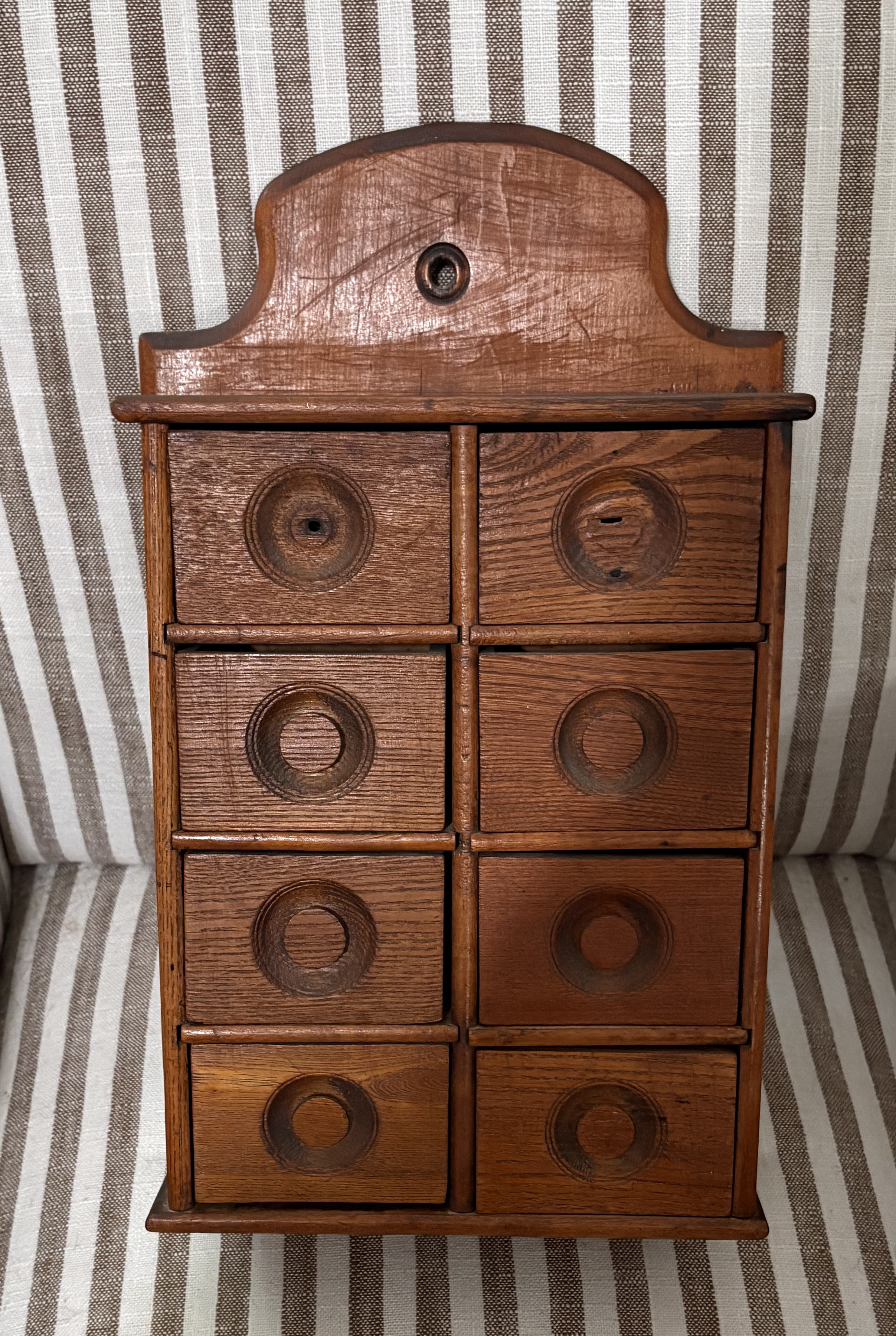
Her great-granddaughter Jessica, who visited as a young child with her mother Phylis and brother Adam, carries her own set of details from the Tama house. There was a little wooden step stool with a diamond-shaped cutout in the middle that she turned into a mailbox, dropping folded letters through the slot. There was a rag doll with a red dress and black hair, and a black rocking chair with blue ABCs on it. These are the memories of a child who felt entirely at home.
Her great-grandson Todd — her granddaughter Ann's eldest son — mowed Agnes and Milo's lawn starting around fourth grade, riding his bike straight east from his other grandparents' house on 7th Street all the way to the end of the road. That was Agnes and Milo's place, before a housing addition grew up around them. He and his brother Eric slept over more than once, and they found it a fine adventure. Fall mowing had its own hazards: the apple tree behind the house left the yard littered with windfalls, and once Todd sent one shooting off the mower blade straight into the side of the house, right next to the bedroom window.
Washington Manor
After Milo died in October 1987, Agnes eventually moved to a small apartment in Belle Plaine called Washington Manor. It was a modest place, and she never complained about it. Her granddaughter Phylis, who lived in Toledo, would drive down on Friday nights when her husband Denny had ballgames in Belle Plaine — stopping to pick up pizza, then visiting Great-Grandma before heading to the game. Her great-granddaughter Jessica, on those visits, remembers a glass dish of assorted toffee candies in foil wrappers on the table — butter rum were her favorites.
Phylis had taken to making Agnes's clothing herself in those later years: sweatshirts and shoes and slippers with velcro closures, so that Agnes, whose hands were badly affected by rheumatoid arthritis, could dress herself more easily. Every Christmas, she received a new sweatshirt outfit. It was a small, practical kindness of the kind that never gets written down until now.
Her Table
Every grandchild who ever ate at Agnes's table has a version of the same story. The kolaches were smaller and more compact than the ones her own daughter made — her granddaughter Mary described them as "shrunken" — but they tasted just as good, and better still when Agnes warmed them in the electric skillet until the edges crisped and the filling went soft. Her granddaughter Karen, Hubert's daughter, loved the prune ones especially.
The sugar cookies were a separate category entirely. Agnes's were not rolled out — pressed flat with the bottom of a glass dipped in sugar, with both oil and butter in the dough, which is the reason they melted in your mouth. Phylis still makes them. Then there were the toffee bars — a brown sugar base with chocolate chips melted over the top — which everyone agreed tasted better than any recipe tried since, though no one could say exactly why. There was Thanksgiving scalloped corn with a crusty top. There was sauerkraut that drew particular praise. Agnes went out into the country somewhere to harvest filberts — hazelnuts — and used them in pies.
And there were the Popitees. Agnes called puff corn "Popitees" and kept it in a tin can, always on hand when the grandchildren came. She would say she didn't want any — then eat it happily the moment someone put a bowl in front of her.
Her Hands
Agnes crocheted through nearly all of it. Afghans — several grandchildren received one as a wedding gift. Baby blankets. Christmas decorations: a crocheted tree, a Mr. and Mrs. Snowman, a cover for a large coffee can that turned it into a little house, doorknob covers. Doilies that looked like fine tatting but were crocheted. And tablecloths — even when her hands were badly swollen with arthritis, she kept on, working in small four-inch squares, piecing them together one section at a time. A few grandchildren have one. Her great-granddaughter Jessica remembers a mint green shawl with a hood that Agnes made for her when she was small — she loved to wear it. Todd confirms it from a great-grandchild's vantage point: whenever he and Eric came to visit, Agnes was always crocheting or cooking or baking. That was simply what she did.
A Quiet Faith
At some point Milo stopped attending the Catholic church after a dispute over a pew. The grandchildren noted her absence from church, and understood it only later. What struck every one of them was that it did not seem to diminish her. Her faith showed up not in observance but in disposition. Her granddaughter Mary said it most plainly: "I don't think you have that kind of joy without a faith in God."
Near the end of his life, as his health declined, Grandpa Milo began speaking only in Czech. Agnes would translate his stories for the family when they visited. Some of those stories she refused to translate. She would turn red and simply tell him: "I am not going to repeat that."
What Everyone Remembered
If you gathered everyone who contributed to this chapter and asked them to name the one thing they remembered most, they would give you the same answer. She always had a smile and she never complained.
Not about the farm work. Not about the mastectomy. Not about the small apartment after Milo died. Not about arthritic hands that could no longer hold a pan or a crochet hook the way they once had. Not about spending seventeen years cleaning other people's houses to supplement the household income. Her granddaughter Karen asked her once whether she had wanted to get married at sixteen. Agnes said that was just the way it was done back then — school until eighth grade, work on the farm, then marriage. It was a statement of fact, not complaint.
She had small phrases that everyone remembered. When the light got low in the house, she'd say "make a light" — the old Czech way of putting it. She said "birth a day" for birthday, a remnant of the language she'd spoken from childhood. Karen, reflecting on a lifetime of visits, said simply that she had grown up wanting to be a grandma just like Grandma Rebik.
The first time her great-grandson Todd brought his future wife Deb home to Iowa to meet the family, she was amazed. Her own grandparents were already gone. Todd not only had grandparents — he had a great-grandmother, and Deb got to meet her.
While recollecting these memories — in particular her quiet refusal to complain despite a life that asked so much of her — her granddaughter Jane said it best:
"If you asked her, she would not say she had a hard life. She would say some things were hard to do — but my life was not hard."
Agnes remembered what by any measure was a hard life with what her family recognized as great joy. They all said so, and none of them could quite explain it. That may be the point.
